about Edward Hopper The House by the Railroad
- vous Ysuov
- Oct 28, 2025
- 4 min read

Architecture of Solitude Built from Sunlight

Edward Hopper’s The House by the Railroad
At high noon the sunlight slices along the eaves, and the window glass answers with dense darkness. The railroad track that spans the foreground seems to pin the viewer’s feet, sealing off the scene, while the Victorian house beyond stands frozen in windless air. The House by the Railroad strips away the city’s noise and builds modern solitude from nothing but light and shadow. The first impression is simple, but the longer you look, the silence of the landscape trembles with the complexity of a person’s inner life.
What, Who, When, How, Where

Edward Hopper’s The House by the Railroad with a railroad and Victorian house in stark contrast
Title: The House by the Railroad (in Korea also known as “수면의 집 / 철로변의 집”)
Artist: Edward Hopper (1882–1967)
Year: 1925
Medium: Oil on canvas
Dimensions: approx. 61.0 × 73.7 cm (24 × 29 in)
Collection: The Museum of Modern Art (MoMA), New York
Even these bare facts signal a turning point in Hopper’s art. Despite its modest size, The House by the Railroad compresses his core motifs—light, windows, distance, unpeopled architecture—into one image.
A Moving Gaze, a Motionless House
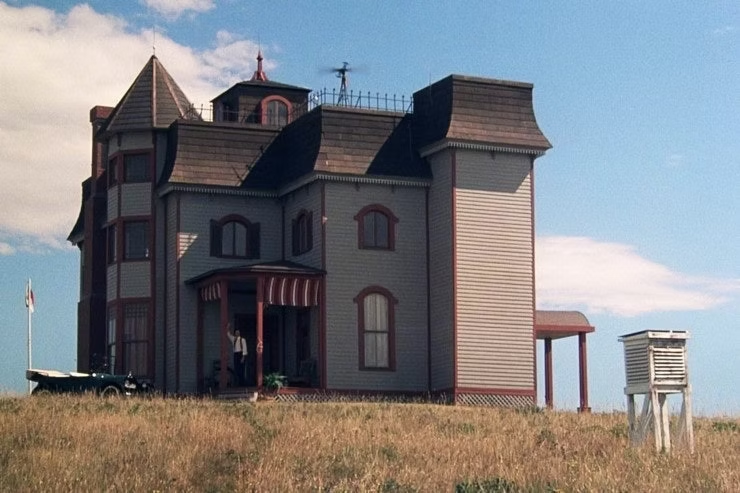
Edward Hopper’s The House by the Railroad with a railroad and Victorian house in stark contrast
Hopper drew subjects from everyday transit and observation: suburban houses glimpsed from train windows, the long, thin shadows of afternoon light, the faint anxiety produced by the absence of people. The House by the Railroad fixes that “rushing gaze” into a frontal view. It can look as chilly as architectural photography, yet the angle of light, the darkness of windows, and the severing line of the track slowly release an emotional aftertaste. Hopper discards literary narration and writes a story with light and structure alone—and here he perfects that method.
1920s America: Speed and Borders

After World War I, the United States surged in industry, railways, cinema, and advertising. Rail transformed the suburbs; the Victorian house symbolized “yesterday’s glory.” By confronting those two worlds—the track in the front plane and the old house in the distance—Hopper lets modern speed and historical stasis mirror one another.
The railroad means movement and fracture at once; the house implies shelter and isolation at once. The optimism and unease of the 1920s knot together in this single scene.
Where American Realism Meets Precisionism
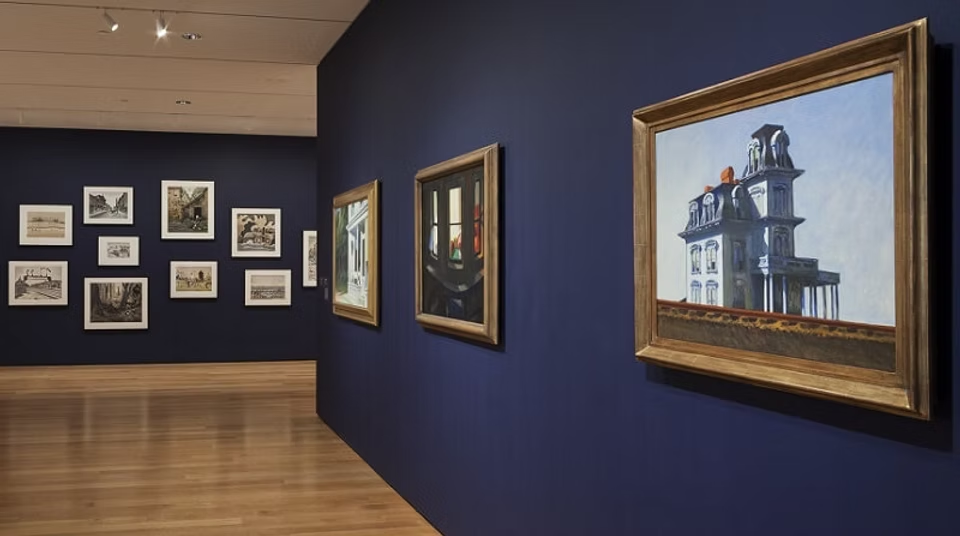
Foreground rail blocking the frame with a full view of the house beyond
Hopper works within the broad arc of American Realism, treating everyday scenes with sober clarity, yet he shares with Precisionism a geometric economy and a cool gaze at industrialized landscapes. Precisionists often stop at formal rigor; The House by the Railroad plants “emotional resonance” inside the same economy. Vertical and horizontal axes, the absence of figures, the firm planar handling of architecture—these formal choices generate a vacuum of feeling. In that acoustics, Hopper’s tone is unlike anyone else’s of his time.
A Precise Design of Composition, Light, Color, and Symbol
A First-Person Barrier Edward Hopper The House by the Railroad

Hard-edged shadows cutting across steps and railing
The heavy rail that crosses the canvas bottom interrupts the viewer’s approach. Because of this barricade, we cannot enter—only look. The painting fixes us as “the person stranded across the road,” building an aesthetics of distance. Self-exclusion becomes a device: we cannot step into the house, so we must interpret the solitude wrought by sunlight.
Bright Planes vs. Black Voids
Hard-edged shadows cutting across steps and railing
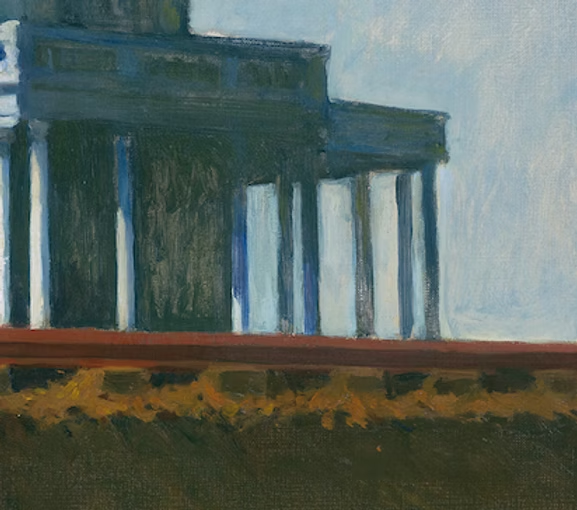
Strong cross-light—likely late afternoon—lays sharp highlights along the eaves and chimneys. The windows, by contrast, are emptied into solid darkness. Beyond simple contrast, this sets up a metaphor: an outer world of social brightness, movement, industry, and an inner world of memory, identity, shadow. In The House by the Railroad, the window is not a conduit between inside and out; it’s a gravitational pit that drags the image inward.
Dry Air, Quiet Planes
Hard-edged shadows cutting across steps and railing
Hopper’s restrained palette—ashy sky, beige and gray-brown weathered wood, a faint ruddy warmth near sundown—removes visual noise. The brushwork is not thick, but edges are crisp, so that the house’s angles feel as if they’re being shaved by light. Like a silent reading, the color speaks in a low voice and lingers.
Second-Empire Melancholy

Hard-edged shadows cutting across steps and railing
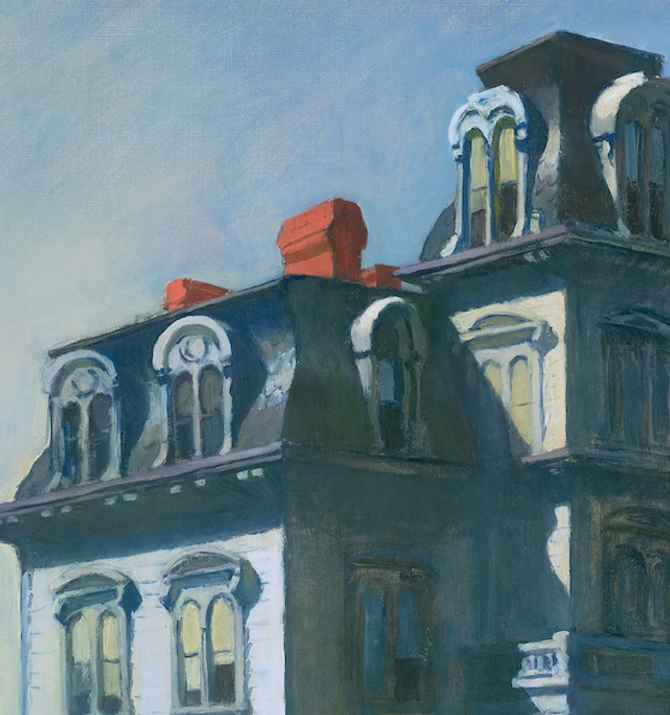
The mansard roof, tower, and ornamental moldings suggest late-nineteenth-century prosperity, but no figures or garden remain to share it. Ornate quiet amplifies loneliness. The house reads like a home with its “owner gone,” inviting viewers to fill in the narrative lacuna on their own.
A Suspenseful Frame

Close-up of a Second-Empire mansard roof and tower details
The bold crop of the track below and the frontal close-up on the façade produce a film-still effect. Movement halts; only suspense remains. Considering how much this image later influenced movies and photography—especially the “psychological backdrop” of an isolated Victorian mansion—The House by the Railroad has left a fingerprint across visual culture.
Greater Isolation in an Age of Hyper-Connection

Sun-bleached wood texture and subtle planar brushwork
Paradoxically, the more hyper-connected the 21st century becomes, the sharper isolation feels. The track (platforms, networks) lies close at hand, yet we often drift farther from the house (the self, the inner room). Hopper’s painting proves this contradiction with the simplest devices. Standing before it, we ask which line we are on—connection or severance.
A Long-Resonating Scene Built from Light

Low crop suggesting a train-window perspective
To see this work well, you need a patient gaze rather than a quick read: the rail’s hard horizontal, the knife-edge highlights along the eaves, the deep hush of the windows, and your own position. The House by the Railroad does not shout; it takes time to fissure the heart. If you meet the original at MoMA, stand “one step back” from the track and listen to that arrested afternoon to the very end. The day will fold differently for you afterward.
Edward Hopper The House by the Railroad
Edward Hopper The House by the Railroad
Edward Hopper The House by the Railroad

Comments